Your BYD’s cabin filter is a CN95 rated HEPA element, and HEPA filtration only works in one direction. The filter has an arrow printed on it showing which way the air travels. If it is fitted the other way round, it does not filter properly, and if the housing cover does not seal, air goes around the element instead of through it.
Mine came back from a routine service installed against its own arrow, with the compartment cover broken. The symptom that gave it away was the windows fogging up heavily the next day. Checking takes about two minutes and needs no tools. It is behind the glovebox.
The symptom
The day after a routine service, the windows fogged up much more than usual. Not slightly. The way they do when a cabin filter is blocked.
I have replaced this filter before, so rather than book another appointment I decided to look at the work myself.
I opened the glovebox, and two things were wrong.
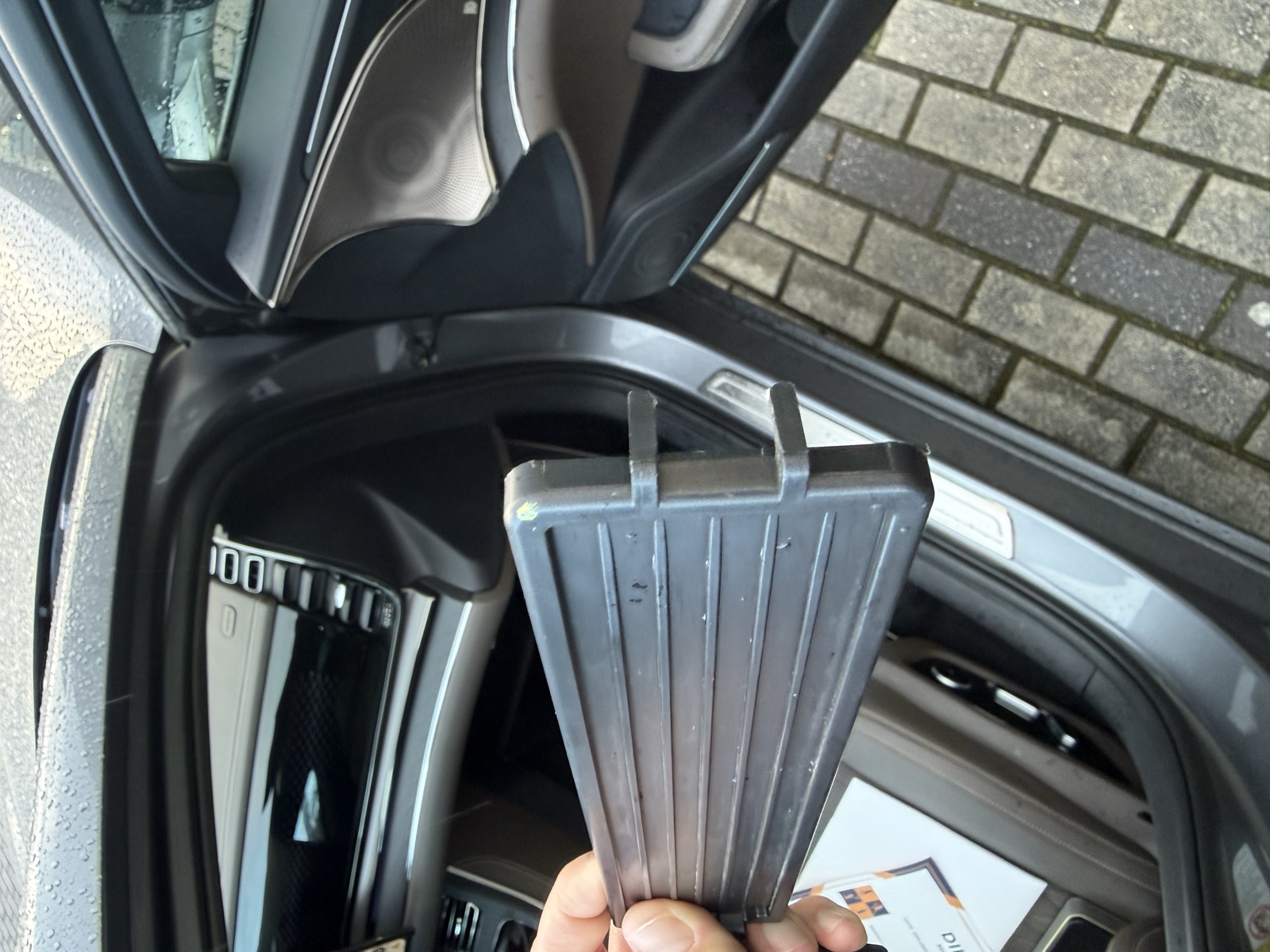
The cover of the cabin filter compartment was broken. Not worn out, broken, the retaining latch snapped off, the way something goes when it is forced.
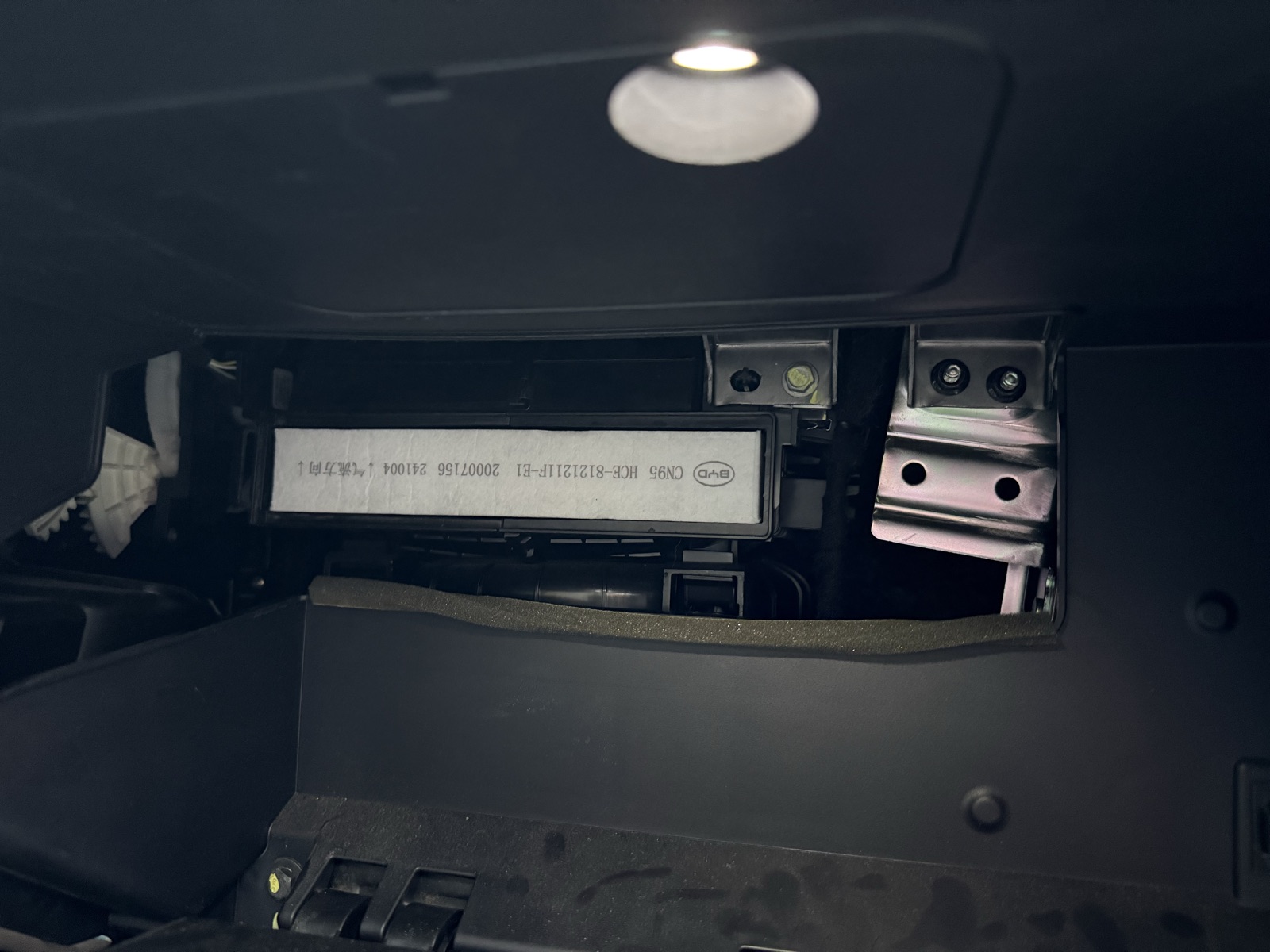
And the filter itself was in backwards. Fully inverted, against the direction of airflow marked on the filter.
What the label actually says
This is the part I like, because the filter documents its own installation.
The label on the frame reads, in order: the BYD logo, CN95, the part number HCE-8121211F-E1, then 20007156 and 241004, and then, in Chinese, 气流方向 with an arrow on each side of it.
气流方向 means airflow direction. The arrows point the way the air is meant to travel through the element.
In the photograph above, taken as the car was handed back to me, that entire label is upside down. Which means the arrows are pointing the opposite way to the one intended. You do not need to know anything about filtration to see it. The part tells you itself, in print, on its own frame.
I take 241004 to be a manufacturing date, 4 October 2024, though I have not confirmed that. 20007156 I cannot account for, so I am simply reporting what is printed.
If you want the number for ordering: HCE-8121211F-E1, CN95 rated. That is the element that was in my Han.
Why the direction matters
A cabin filter is not a sponge that works equally well either way up.
The CN95 rating means it is a HEPA style element, and HEPA filtration is directional by design. The layers are arranged so that air passes through them in a particular order, coarse to fine. Reverse the flow and you are pushing air through the pack the wrong way, and it does not do the job it was built for. That is precisely why the manufacturer prints an arrow on the frame rather than leaving it to taste.
So an inverted filter is not a slightly worse filter. It is a filter that has stopped being one.
Why the broken cover matters just as much
The second fault is arguably worse, and easier to overlook.
The filter sits in a housing, and the housing has a cover that seals it. Air is supposed to be obliged to pass through the element because there is nowhere else for it to go.
Break the latch so the housing no longer closes properly, and you have given the air an easier route. It goes around the filter instead of through it. Air always takes the path of least resistance, and an unsealed housing is a much easier path than a dense HEPA pack.
So I had an expensive decorative rectangle sitting behind my glovebox. Which probably also explains the fogging: moisture was not being handled, because nothing was really being filtered.
How to check yours, in two minutes
No tools needed.
- Open the glovebox and empty it. The filter compartment is behind it.
- Find the compartment cover and look at it before you remove it. Check the latch and the edges. If it is cracked, snapped, or does not clip shut with any resistance, that is a fault in itself.
- Take the cover off and slide the filter out. Note which way round it came out before you change anything.
- Find the arrow on the frame. Look for
气流方向with an arrow either side. On my element the print sits along the long edge of the frame. - Compare. With the filter sitting in the housing as it was, the print should be the right way up and the arrows should point the way the air flows, not back at you. If the whole label reads upside down, so do the arrows.
- Photograph it before you touch it, especially if the car has just come back from a service. If you want anyone to take the finding seriously, you want the picture of it as it was found.
That last step is the one I would emphasise. I only have a case here because I took a photograph before I fixed anything.
What happened when I reported it
I drove straight to the service centre to register both things, the damage to the cover and the installation.
Managers and technicians were present. They told me the filter was installed correctly.
I asked why, in that case, its position contradicted the airflow arrow printed on the filter itself.
Nobody could answer that.
I then fitted the filter myself, according to its own marking. The fogging stopped, which I would treat as the practical end of the argument.
The compartment cover was supposed to be replaced at my next visit. It was not. The parts that had been ordered turned out to be the wrong ones 🙂
What to ask, if you find the same thing
Keep it factual and keep it about the part rather than the person.
- Ask for the finding to be recorded in writing, with the date.
- Ask which way the airflow arrow is supposed to face. It is printed on the component; there is one correct answer.
- If the housing cover is damaged, ask for the part number they intend to order and get it in writing before the appointment. In my case an appointment was booked and nothing was replaced, because the wrong references had been ordered.
- Photograph everything before it is touched, including the old part after removal.
The wider point
I am not writing this because a cabin filter is a serious component. It is close to the least serious thing on the car.
That is exactly why it bothered me. A cabin filter is about the most basic maintenance item there is, with an arrow printed on it in two places. If that is what happens with something simple, I would rather not speculate about the complicated things.
And the fix, again, did not come from a service centre. It came from looking at the part myself, and everything else I know about living with this car has come from other owners. That is the recurring lesson of five years and 50,000 km with a Han in Europe, and I have written about it at more length in the post about the 12V battery, where a group of owners solved in one minute what a workshop could not solve in weeks.
So the advice is the same one I keep arriving at. Find the BYD owners in your own country and talk to them. The car is identical everywhere. What differs is whether anyone near you knows how to service it.
If you have a Han, go and look behind your glovebox. It takes two minutes, and you might be surprised.
FAQ
Can a cabin filter be installed the wrong way round?
Yes, and on a BYD it matters. The element is CN95 rated, which is a HEPA style filter, and HEPA filtration is directional. There is an airflow arrow printed on the frame. Installed against that arrow the filter does not do its job properly.
Where is the cabin filter on a BYD Han?
Behind the glovebox. Empty the glovebox and the compartment is accessible from there, with a plastic cover held by a latch. No tools are needed to look at it.
What is the cabin filter part number for a BYD Han?
The element in mine is marked HCE-8121211F-E1, CN95 rated, with 20007156 and 241004 also printed on the frame. Check against your own car before ordering, since specifications vary by model and year.
How do I know which way round it goes?
Look for 气流方向 printed on the frame, with an arrow on either side. That is Chinese for airflow direction. Fitted correctly, the print reads the right way up and the arrows point the way the air travels.
My BYD’s windows are fogging up. Is it the cabin filter?
It is worth checking, and it costs nothing to do. Heavy fogging is the classic symptom of a blocked cabin filter, and in my case it was a filter that had been fitted backwards in a housing that no longer sealed. Check it before you book anything.
Does a broken filter housing cover matter?
Yes. The cover seals the housing so that air has to pass through the element. If it no longer seals, air bypasses the filter, and it makes little difference how good the filter is.
Should I replace the filter myself?
It is one of the few jobs on this car that needs no tools and no diagnostics. I do mine. If nothing else, checking it yourself tells you whether the last person to do it got it the right way round.
Leave a comment